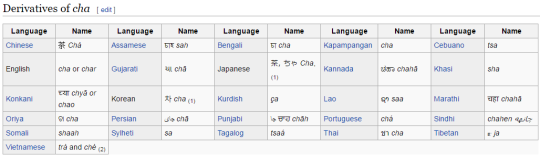
is “chai” a TYPE of tea??! bc in Hindi/Urdu, the word chai just means tea
its like spicy cinnamon tea instead of bland gross black tea
I think the chai that me and all other Muslims that I know drink is just black tea
i mean i always thought chai was just another word for tea?? in russian chai is tea
why don’t white people just say tea
do they mean it’s that spicy cinnamon tea
why don’t they just call it “spicy cinnamon tea”
the spicy cinnamon one is actually masala chai specifically so like
there’s literally no reason to just say chai or chai
They don’t know better. To them “chai tea” IS that specific kind of like, creamy cinnamony tea. They think “chai” is an adjective describing “tea”.
What English sometimes does when it encounters words in other languages that it already has a word for is to use that word to refer to a specific type of that thing. It’s like distinguishing between what English speakers consider the prototype of the word in English from what we consider non-prototypical.
(Sidenote: prototype theory means that people think of the most prototypical instances of a thing before they think of weirder types. For example: list four kinds of birds to yourself right now. You probably started with local songbirds, which for me is robins, blue birds, cardinals, starlings. If I had you list three more, you might say pigeons or eagles or falcons. It would probably take you a while to get to penguins and emus and ducks, even though those are all birds too. A duck or a penguin, however, is not a prototypical bird.)
“Chai” means tea in Hindi-Urdu, but “chai tea” in English means “tea prepared like masala chai” because it’s useful to have a word to distinguish “the kind of tea we make here” from “the kind of tea they make somewhere else”.
“Naan” may mean bread, but “naan bread” means specifically “bread prepared like this” because it’s useful to have a word to distinguish between “bread made how we make it” and “bread how other people make it”.
We also sometimes say “liege lord” when talking about feudal homage, even though “liege” is just “lord” in French, or “flower blossom” to describe the part of the flower that opens, even though when “flower” was borrowed from French it meant the same thing as blossom.
We also do this with place names: “brea” means tar in Spanish, but when we came across a place where Spanish-speakers were like “there’s tar here”, we took that and said “Okay, here’s the La Brea tar pits”.
Or “Sahara”. Sahara already meant “giant desert,” but we call it the Sahara desert to distinguish it from other giant deserts, like the Gobi desert (Gobi also means desert btw).
Languages tend to use a lot of repetition to make sure that things are clear. English says “John walks”, and the -s on walks means “one person is doing this” even though we know “John” is one person. Spanish puts tense markers on every instance of a verb in a sentence, even when it’s abundantly clear that they all have the same tense (”ayer [yo] caminé por el parque y jugué tenis” even though “ayer” means yesterday and “yo” means I and the -é means “I in the past”). English apparently also likes to use semantic repetition, so that people know that “chai” is a type of tea and “naan” is a type of bread and “Sahara” is a desert. (I could also totally see someone labeling something, for instance, pan dulce sweetbread, even though “pan dulce” means “sweet bread”.)
Also, specifically with the chai/tea thing, many languages either use the Malay root and end up with a word that sounds like “tea” (like té in Spanish), or they use the Mandarin root and end up with a word that sounds like “chai” (like cha in Portuguese).
So, can we all stop making fun of this now?
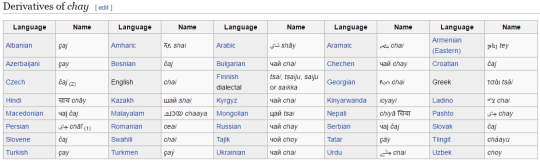
Okay and I’m totally going to jump in here about tea because it’s cool. Ever wonder why some languages call tea “chai” or “cha” and others call it “tea” or “the”?
It literally all depends on which parts of China (or, more specifically, what Chinese) those cultures got their tea from, and who in turn they sold their tea to.
The Portuguese imported tea from the Southern provinces through Macau, so they called tea “cha” because in Cantonese it’s “cha”. The Dutch got tea from Fujian, where Min Chinese was more heavily spoken so it’s “thee” coming from “te”. And because the Dutch sold tea to so much of Europe, that proliferated the “te” pronunciation to France (”the”), English (”tea”) etc, even though the vast majority of Chinese people speak dialects that pronounce it “cha” (by which I mean Mandarin and Cantonese which accounts for a lot of the people who speak Chinese even though they aren’t the only dialects).
And “chai”/”chay” comes from the Persian pronunciation who got it from the Northern Chinese who then brought it all over Central Asia and became chai.
This is the post that would make Uncle Iroh join tumblr
Tea and linguistics. My two faves.
Okay, this is all kinds of fascinating!
Quality linguistic research
Btw I love how most languages pick one, but Finnish is like “ok we call it ‘tee’ officially, but these few dialects call it tsai/tsaiju/saikka/saiju”.
And then there’s Polish and friends being special again with herbata.
In French we have “Thé” which is tea, and “Tisane” which is herbal tea. But let’s face it, tea and herbal tea is pretty much the same thing and I have no idea why there are two names for the same damn thing other than the fact that herbal tea is slightly lighter in colour than tea.
English, the language that mugs other languages in back alleys and rummages in their pockets for spare vocabulary.
for those of you having difficulty pronouncing her name, the apostrophe in her first name is not actually an apostrophe! its a bit of hawaiian punctuation called an ʻokina. because hawaiian tends to be very vowel-heavy and can have multiple consecutive vowel sounds with no consonants dividing them, the ‘okina serves an indicator of a pause between vowel sounds (a glottal stop if we’re being technical).
so auli’i would be pronounced like OW-LEE-EE rather than OW-LEE. cravalho is likely an anglicization of the portuguese surname, carvalho, which makes sense because hawaii has a pretty large portuguese population. (for example, i have a friend who’s last name, loui, is a messed up attempt at anglicizing the chinese name, liu).
usually the ‘okina is removed from hawaiian words outside of hawaii to avoid confusing people who are unfamiliar with the language’s conventions. for example, hawaii would actually be hawai’i, ohana would be ‘ohana, and luau would be lu’au (there’s actually supposed to be a straight bar above the first ‘u’ called a kahako, which lengthens and emphasizes the vowel, but im too lazy to try to format that lol).
and that concludes this linguistic primer on hawaiian punctuation, have a great day y’all.
The Greeks had this word, right, we have no idea where it came from, it just kinda popped up out of nowhere, and it could mean either apples, cheeks, or boobs. Problem is it looked and sounded *exactly* like another, unrelated word which could mean sheep, goat, or any animal in general really, which must have got confusing if you were a farmer talking about your livestock, but anyway…
Then the Romans, having stolen practically everything else from the Greeks, thought they’d nick this word too, because Latin isn’t confusing enough without throwing in a bunch of loan words. And they adopted it to mean a pumpkin.
Then the English came along and were all like “when in Rome”, and stole it, where it became our word ‘melon’. Which has now come back to mean boobs.
ĺm valot yafot, timo’ ím sh’lom – Be he bright Vala, beautiful or defiled
Yilade’ Morgot, Child of
Morgoth,
Ha’eldar, ím ha’maiarot – Eldar Or Maiar
Ov rídfu, ha’adam al’ ha’adam- Or
following, man on earth
Lo ha’tora’, lo ha’hesed- Not
law, not loving faithfulness
Lo édét herevím- Nor council
of swords
Lo yira’, lo hoshekh, lo tsalmavét- Not fear, not darkness, not the shadow of mortal death
Vayiga’el mín ha-Feanaro. – Will
protect him from Feanaro.
Et _am ha’Feanaro. And from
the people of Feanaro.
Ata, ashér, va’híhavatem, va’híqavartem. You, who would cause to be hidden, who would cause to be buried
ĺm ata’ va’hilkhadtem, miyadikhem – If you cause to be taken from our hands
Matsatem, vahiyarashtem, vahishalakhtem ha silmralim’- If you find, if you cause to be stolen, if
you cast away the silmarils-
Zot nishvadnu shamayim. – This
we swear to the heavens.
Bayom hahu, vaharag bíyadoténu. – On that day, you will die by the cause of our hands.
Ha’tsara’ _ad ha’qétsat ha’adama- Woe unto the ending of the world
Shma dvarímenu, Eru av’kol- Hear
our words, Eru father-of-all,
Li’ha’olám hoshékh – To the
eternity of darkness
Tsalmavet lanu- The shadow
of mortal death to us
‘Al va-kashakhnu – Lest we deceive
Al’ har kadésh, – Upon the
holy mountain
Shma, anakhnu – Hear us
Varda, Manwe! – Varda,
Manwe!
So here, at last, is my Ancient Hebrew translation of the Oath of Feanor! I obviously still need do the write-out in the actual script and maybe an audio version (it sounds pretty badass, I can tell you) but this is the phonetic transcription. Fun details:
Ancient Hebrew actually has a word meaning “the shadow of mortal death”, so that made an AWESOME substitute for “doom”.
“To us” and “we have” are the same, so “the shadow of mortal death to us” also means “we have the shadow of mortal death [already]”. Welp.
“Adam” means both “man/mankind” and “earth/ the earth” so “man upon the earth” turned out awesome- al ha’adam ha’adam.
Maiar is feminine.
Silmaril gets the appropriate vowel shortenings in the plural, so silmralim’.
the thing you need to realize about localization is that japanese and english are such vastly different languages that a straight translation is always going to be worse than the original script. nuance is going to be lost and, if you give a shit about your job, you should fill the gaps left with equivalent nuance in english. take ff6, my personal favorite localization of all time: in the original japanese cefca was memorable primarily for his manic, childish speaking style – but since english speaking styles arent nearly as expressive, woolsey adapted that by making the localized english kefka much more prone to making outright jokes. cefca/kefka is beloved in both regions as a result – hell, hes even more popular here
yes this
a literal translation is an inaccurate translation.
localization’s job is to create a meaningful experience for a different audience which has a different language and different culture. they translate ideas and concepts, not words and sentences. often this means choosing new ideas that will be more meaningful and contribute to the experience more for a different audience.
There was an example during late Tokugawa period in Japan where the translator translated, "Я люблю Вас” (I love you), to “I could die for you,” while translating
Ася, (
Asya) a novel by Ivan Turgenev. This was because a woman saying, “I love you,” to a man was considered a very hard thing to do in Japanese society.
In a more well-known example,
Natsume Soseki, a great writer who wrote, I am a Cat, had his students translate “I love you,” to “the moon is beautiful [because of] having you beside tonight,” because Japanese men would not say such strong emotions right away. He said that it would be weird and Japanese men would have more elegance.
Both of these are great examples of localization that wasn’t a straight up translation and both of these are valid. I feel like a lot of people forget the nuances in language and culture and how damn hard a translator’s job is and how knowledgeable the person has to be about both cultures. [x]
Important stuff about translation!
Note that you can apply this to your own translations even if they aren’t big pieces of literature or something. Don’t feel bad about not translating word for word. An everyday sentence may sound odd translated literally – it’s okay to edit a little bit so it feels right!
Oh my god, I’m about to go on a ramble, I’m sorry, I can’t help it, the inner translation nerd is coming out. I’m so sorry. The thing is–there is actually no such thing as an accurate translation.
It’s literally an impossible endeavor. Word for word doesn’t cut it. Sense for sense doesn’t cut it, because then you’re potentially missing cool stuff like context and nuance and rhyme and humor. Even localization doesn’t really cut it, because that means you’re prioritizing the audience over the author, and you’re missing out on the original context, and the possibility of bringing something new and exciting to your host language. Foreignization, which aims to replicate the rhythms of the original language, or to use terminology that will be unfamiliar to the target culture–(for example: the first few American-published Harry Potter books domesticated the English, and traded “trousers” for “pants”, and “Mom” for “Mum”. Later on they stopped, and let the American children view such foreignizing words as “snog” and “porridge.”)–also doesn’t cut it, because you risk alienating the target readers, or obscuring meaning.
Another cool example is Dante, and the words written above the gates of hell: Abandon hope, all ye who enter here.
In the original Italian, that’s Lasciate ogne speranza, voi ch’intrate. Speranza, like most nouns in latinate languages, has a gender: la. Hope, in Italian, is gendered female. Abandon hope, who is female. Abandon hope, who is a woman. When the original Dante enters hell, searching for Beatrice, he is doomed, subtly, from the start. That’s beautiful, subtle, the kind of delicate poetic move literature nerds gorge themselves on, and you can’t keep it in English. Literally, how do you preserve it? We don’t have a gendered hope. It doesn’t work, can’t work. So how do you compensate? Can you sneak in a reference to Beatrice in a different line? Or do you chalk her up as a loss and move onto the next problem?
You’re always going to miss something–the cool part is that, knowing you’re going to fail, you get to decide how to fail. Ortega y Gasset called this The Misery and Splendor of Translation. Basically, translation is impossible–so why not make it a beautiful failure?
My point is that literary translation is creative writing, full of as many creative decisions as any original poem or short story. It has more limitations, rules, and structures to consider, for sure–but sometimes the best artistic decision is going to be the one that breaks the rules.
My favorite breakdown of this is Le Ton Beau De Marot, a beautiful brick of a translator’s joke, in which the author tries over and over again to create a “perfect” translation of “A une Damoyselle Malade”, an itsy bitsy poem Clement Marot dashed off to his patron’s daughter, who was sick, in 1537.
This is the poem:
Ma mignonne, Je vous donne Le bon jour; Le séjour C’est prison. Guérison Recouvrez, Puis ouvrez Votre porte Et qu’on sorte Vitement, Car Clément Le vous mande. Va, friande De ta bouche, Qui se couche En danger Pour manger Confitures; Si tu dures Trop malade, Couleur fade Tu prendras, Et perdras L’embonpoint. Dieu te doint Santé bonne, Ma mignonne.
Seems simple enough, right? But it’s got a huge host of challenges: the rhyme, the tone, the archaic language (if you’re translating something old, do you want it to sound old in the target language, too? or are you translating not just across language, but across time?)
Le Ton Beau De Marot is a monster of a book that compiles all of Hofstader’s “failed” translations of Ma Mignonne, as well as the “failed” translations of his friends, and his students, and hundreds of strangers who were given the translation challenge (which you can play here, should you like!)
The end result is a hilarious archive of Sweet Damosels, Malingering Ladies, Chickadees, Fairest Friends, and Cutie Pies. It’s the clearest, funniest, best example of what I think is true of all literary translations: that they’re a thing you make up, not a thing you discover. There is no magic bridge between languages, or magic window, or magic vessel to pour the poem from one language to another–translation is always subjective, it’s always individual, it’s always inaccurate, it’s always a failure.
It’s always, in other words, art.
Which, as a translator, I find incredibly reassuring! You’re definitely, one hundred percent absolutely, gonna fuck up. Which means you can’t fuck up. You can take risks! You can experiment! You can do cool stuff like bilingual translations, or footnote translations! You write your own code of honor, your own rules that your translations will hold inviolable, and fuck it if that code doesn’t match everyone else’s*. The translations they hold inviolable are also flawed, are failures at the core, from the King James Bible right on down to No Fear Shakespeare. So have fun! It’s all in your hands, miseries and splendors both.
As french is my mother tongue and my father is a long-suffering translator, I feel like NEED to get a copy of that book for our family. Like, absolutely NEEEED it.
I think the first time I really admired a translation was in Harry Potter, actually. A lot of the characters got name changes when translating into french. When they introduce Oliver Wood, for example, he’s introduced in a pun.
Harry is in trouble, and McGonagall tells him to follow her, then interrupts a class to “borrow Wood”. Harry think she’s borrowing a stick to hit him. (I have a host of feels about an 11 y-o assuming he’s about to be hit with a stick, but time and place.) Oliver Wood comes out, haha.
In french, that won’t work. “Puis-je emprunter Wood/Bois” would not in any way make sense, except if it was someone’s name, so the joke fails. Do you cut out Harry’s reaction, or change Oliver’s name?
There’s a common format of french family names- Du/De la/Des, all meaning “from the”. Du Rosier, De La Salle, D’Allaire, Des Lauriers, etc. But “du” can also mean “some”. The easiest way to preserve the joke was to change Oliver’s name to “Du bois”, which made “Puis-je emprunter Du bois” / “Can I borrow some wood”. The joke works perfectly, and Olivier Dubois has a perfectly normal french name. Kinda thing most people wouldn’t even notice. Totally seamless, totally french, totally unremarkable. I remember being floored by how slick that translation job was.
Imagining a translator trying to come up with a fix for that simple introduction of a relatively minor character makes me really happy. I hope someday someone notices a translation by my dad and is similarly impressed by his cleverness.
@shallicomparetheetolagrenouille this is exactly why you’re so freaking impressive to me, I know you’re doing rockstar shit like this ❤
wend
You rarely see a “wend” without a “way.” You can wend your way through a crowd or down a hill, but no one wends to bed or to school. However, there was a time when English speakers would wend to all kinds of places. “Wend” was just another word for “go” in Old English. The past tense of “wend” was “went” and the past tense of “go” was “gaed.” People used both until the 15th century, when “go” became the preferred verb, except in the past tense where “went” hung on, leaving us with an outrageously irregular verb.
deserts
The “desert” from the phrase “just deserts” is not the dry and sandy kind, nor the sweet post-dinner kind. It comes from an Old French word for “deserve,” and it was used in English from the 13th century to mean “that which is deserved.” When you get your just deserts, you get your due. In some cases, that may mean you also get dessert, a word that comes from a later French borrowing.
eke
If we see “eke” at all these days, it’s when we “eke out” a living, but it comes from an old verb meaning to add, supplement, or grow. It’s the same word that gave us “eke-name” for “additional name,” which later, through misanalysis of “an eke-name” became “nickname.”
sleight
“Sleight of hand” is one tricky phrase. “Sleight” is often miswritten as “slight” and for good reason. Not only does the expression convey an image of light, nimble fingers, which fits well with the smallness implied by “slight,” but an alternate expression for the concept is “legerdemain,” from the French léger de main,“ literally, “light of hand.” “Sleight” comes from a different source, a Middle English word meaning “cunning” or “trickery.” It’s a wily little word that lives up to its name.
roughshod
Nowadays we see this word in the expression “to run/ride roughshod” over somebody or something, meaning to tyrannize or treat harshly. It came about as a way to describe the 17th century version of snow tires. A “rough-shod” horse had its shoes attached with protruding nail heads in order to get a better grip on slippery roads. It was great for keeping the horse on its feet, but not so great for anyone the horse might step on.
fro
The “fro” in “to and fro” is a fossilized remnant of a Northern English or Scottish way of pronouncing “from.” It was also part of other expressions that didn’t stick around, like “fro and till,” “to do fro” (to remove), and “of or fro” (for or against).
hue
The “hue” of “hue and cry,” the expression for the noisy clamor of a crowd, is not the same “hue” as the term we use for color. The color one comes from the Old English word híew, for “appearance.” This hue comes from the Old French hu or heu, which was basically an onomatopoeia, like “hoot.”
lurch
When you leave someone “in the lurch,” you leave them in a jam, in a difficult position. But while getting left in the lurch may leave you staggering around and feeling off-balance, the “lurch” in this expression has a different origin than the staggery one. The balance-related lurch comes from nautical vocabulary, while the lurch you get left in comes from an old French backgammon-style game called lourche. Lurch became a general term for the situation of beating your opponent by a huge score. By extension it came to stand for the state of getting the better of someone or cheating them.
umbrage
“Umbrage” comes from the Old French ombrage (shade, shadow), and it was once used to talk about actual shade from the sun. It took on various figurative meanings having to do with doubt and suspicion or the giving and taking of offense. To give umbrage was to offend someone, to “throw shade.” However, these days when we see the term “umbrage” at all, it is more likely to be because someone is taking, rather than giving it.
shrift
We might not know what a shrift is anymore, but we know we don’t want to get a short one. “Shrift” was a word for a confession, something it seems we might want to keep short, or a penance imposed by a priest, something we would definitely want to keep short. But the phrase “short shrift” came from the practice of allowing a little time for the condemned to make a confession before being executed. So in that context, shorter was not better.
And speaking of pronouns, flat-out my favorite part of the LOTR Appendices is when it’s revealed that the Gondorian dialect of the Common Speech differentiates between formal and informal second-person pronouns but the distinction’s been lost in the Hobbit’s dialect, so Pippin’s blithely been using familiar terms of address with the Lord of the City, and thus helps to explain both why the Gondorians are so ready to assume he’s a prince and why Denethor finds him so amusing to have around.
fun fact: the reason that the plural of goose is geese but the plural of moose is not meese is because goose derives from an ancient germanic word undergoing strong declension, in the pattern of foot/feet and tooth/teeth, wherein oo is mutated to ee. however ‘moose’ is a native american word added to the english lexicon only ~400 years ago, and lacks the etymological reason to be pluralized in that way.
Oh baby. Keep talking dirty to me.
Oh, lilynoize! My fellow linguist, thank you.
It’s racist to explain the declension of “goose” with its etymology, as if that history—that route of development—is important and then, in the same breath, say that “moose” is “a Native American word.” That’s literally like saying that “goose” is ”a white word.” And it perpetuates the idea that Native histories, cultures, and contributions to mainstream society are less important.
There are almost 300 languages indigenous to North America, making up about 30 distinct language families. Not one of them is called “Native American”.
“Moose” is an Eastern Algonquian word, most likely from the Narragansett language, which means it comes from a genetic group within the Algic language family. And that’s actually interesting for two reasons:
1) Because it shows that, etymologically, the plural of “moose” should be “mosinee.”
2) Because it makes “moose” a word that has almost certainly survived the extinction of its origin language.

 Meg's Mumbles