good God if I am going to do this much research then it might as well benefit the rest of the Black Sails fandom, so here’s a post about 18th-century coffeehouses and what went on at them and what people drank and stuff. This is going to be a multi-part post because it is a whole book’s worth of information.
it is my brand new headcanon just formed this instant while reading this one book about libraries in the Atlantic world that Miranda and Thomas, in addition to doing salons like the big old rhetoric nerds that they are, were regulars at London coffeehouses
This is all coming from The Social Life of Coffee: The Emergence of the British Coffeehouse by Brian Cowan (Yale UP, 2005), which is excellent. I skipped the bits about coffee and commerce because I didn’t care, but hmu if you have questions about that side of things and I will try to find out the answers. Putting this under a cut bc it’s going to be long.
I shall invent a coffeehouse that I have not yet named but it will be run by a single lady with a teenage son and she will be Miranda’s pal because poor Miranda, I want her to have some friends in old-time London. And also that my book says occasionally coffeehouses were run by single ladies. All the information is under the cut.
Drinks you could get:
weak coffee (or mixed with milk to make “milk coffee”) (also this was made with Thames water so try not to think about that too hard)
tea
chocolate drinks (sometimes mixed with eggs, sugar, milk, or a bit of bread, ew)
chocolate with flour in for “breakfast chocolate” (ew)
chocolate with wine in (ew)
sage tea
“content” which was mainly milk and eggs (seriously ew, wtf England)
ratesia (“a drink fortified with brandy”, no further information given)
also alcohols: “mum, mead, metheglin, cider, perry, usquebaugh, brandy, aqua vitae, strong-waters, beer, and ale”
Hours: as early as 6AM to as late as 9 or 10 PM. There were laws against places staying open much later than this, but of course some people flouted that. Still, coffeehouses that were open later than 9 or 10 were suspect in terms of propriety.
Pretty early on in the life of London coffeehouses, there would be clubs that met there regularly for vigorous intellectual debate. The Rota was an early such club; Samuel Pepys paid one and six to be a member. An estimated forty percent of former Rota-men went on to become fellows of the Royal Society. Though the Rota club didn’t last super long, people really remembered it (and made fun of its armchair philosophers), and it established a pattern for coffeehouses as a site of intellectual debate.
Unlike a lot of other places you could go to socialize (like taverns), coffeehouses lacked the association with various kinds of sins. The idea was that men of widely different social status could come and exchange ideas and hang out on relatively equal terms. It was cheap and convenient!
By the 1690s, there were separate chocolate houses. These were posher than coffeehouses. IDK why.
Many coffeehouses acknowledged the Turkish origin of the drink and would have names like The Turk’s Head or The Sultan’s Head or Murad the Great. They were prone to employing vaguely orientalist decorating patterns.
Coffeehouses were Ground Zero for auctions in England. Who the hell knew! Book and art auctions were particularly popular, as well as auctions for rare manuscripts and curios from faraway countries. Will’s Coffeehouse in Westminster was so well known for auctions that it changed its name to the Auction House in 1691. One satire that occurred in pamphlets in the seventeenth century (though it stopped by the eighteenth) was that bachelors and women were being auctioned off. A lot of people found this extremely unamusing; the Athenian Mercury (run by a guy who looooooved the Society for the Reformation of Manners) said “‘Tis a teaguish sort of witticism to dispose of what’s another bodies, without their consent.” TRUE.
Hidden, or disappearing, fore-edge painting is a technique that dates back to the mid 17th century, when London bookbinders began decorating not the flat edge of a text block, but rather the gently fanned edge. Doing so caused the image to appear and vanish depending on how the pages were held. In some cases, as with the views of Boston and Philadelphia above, two different scenes were painted on either side of the fore-edge, so that only the gilt edge is visible until the pages are fanned in one direction or the other.
There’s more about these fore-edge paintings on theFrom the Stacksblog!
Fore-edge painting of York
Cathedral. Thomas and Katharine Macquoid. About Yorkshire. 1894. New-York Historical Society.
Double fore-edge painting
of oval views of Hull and Olney, with decorative surrounds. John Scott. The Life of the Rev. Thomas
Scott, Rector of Aston Sandford, Bucks. 1836. New-York Historical Society.
Double-fore edge paintings
of Boston and Philadelphia. Washington Irving. The Sketch Book of Geoffrey
Crayon, Gent. 1864. New-York Historical Society.
Fore-edge painting of Eton
from Windsor Castle. Thomas Gray. Poems and Letters. 1867. New-York Historical
Society.
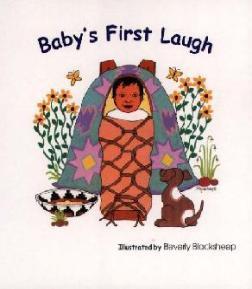
The Navajo have a unique tradition. When a baby is born, it is regarded as the ultimate, precious gift and must never be abused. From the moment of birth, the child is watched over continuously by family and friends, who patiently wait for the child’s first…laugh.
“Has your baby laughed?” is common question posed to parents who have infants around the age of three months. The first laugh of a Navajo child is a very significant event. It marks the child’s final passing from the spirit world to the physical world, meaning he or she is now fully human. This milestone warrants a party, and what a party it is!
Whichever brother, sister, parent, cousin, aunt, uncle, or passing acquaintance is present at the first laugh is deemed to have caused it. The laughter instigator then receives the honored privilege of preparing a special ceremony to welcome the child into society.
Once a baby has laughed, training in generosity begins immediately—a value held in high regard among the Navajo people. At the party, where the baby is considered the host, the parents or person responsible for the first laugh help hold the baby’s hand as he or she ceremonially gives the rock salt, food, and gifts to each guest. There are also bags of candy, money, and other presents that the child “gives” along with the food. [x]
Yes it is true. I have had of a few relatives invite me to a A’wee Chi’deedloh "The Baby Laughed Ceremony" however I have not had the privilege to actually attended one personally. The Dine’ peoples believe that babies are of “two worlds” (Earth people & Holy people) when they are born. The first laugh signifies the babies desire to become a part of the Earth People so it is a great cause for celebration.
A lot of people believe that Joji had better skill and Hands went down too easily, and thus the duels were plot gifts for Flint. I disagree completely. The duels were actually an expose of what makes the ultimate advantage in a duel against an opponent using different weapons other than a broadsword.
Here are basic duel logics on who has the advantage:
1. Skill and expertise in your weapon of choice. Flint is likely one of the best three broadsword fighters in the show. Joji is the expert with his katana. Hands is an expert in wielding two weapons – cutlass and hammer with spike. Flint dispatches several men wielding broadswords with great or relative ease. Billy has less expertise in the broadsword than Hands has with his 2 weapons, and lacks experience in defending against 2 weapons. Hence Hands could dispatch Billy so quickly.
2. Physical fitness and strength. The stronger, the fitter, the more agile, the taller a fighter is the more he has a personal physical advantage over his opponent, and it could make the difference if the duelists are of equal expert skill. Remember the duel between Blackbeard and Flint. Same weapons, same skill, but Flint weakened after living weeks on rations. Duel between Billy and Flint in 4×02: Billy has the length and power over Flint, but just not as skillfull.
3. Distance > manouvaribility > sharpness. The longest weapon has a distance advantage, because it allows the duelist to harm the opponent without requiring your body to come into the danger zone of the opponent’s weapon(s). Joji’s katana is longer than Flint’s broadsword, very flexible in use because of its two handed grip, and deadly sharp overall, more so than a broadsword. Flint’s broadsword however is longer than Israel’s cutlass and hammer, and sharper.
4. Having optimal space for your weapon. You need the space that matches your fighting technqiue and your ability to optimally wield your weapon. While a spear is longer than a sword and can prick someone dead as easily as a swordpoint, theoretically a spear has an advantage over a sword, especially if the spear wielder is an expert in wielding it to block, knock and stab the opponent. But that is only true when the fighter has the space to wield it around. Put the fight in a small corridor and the spear wielder loses that advantage altogether, and would do better in dropping the spear and draw out a dagger instead.
Joji versus Flint
Assume both are equally skilled in their weapon of preference. Joji has the weapon advantage and fighting technique in his optimal space, when he can also use his legs to trip Flint. That is what we see at the start of the duel.
As soon as Flint realizes he is outmatched in this manner and nearly has his head chopped off, he moves away from Joji’s optimal space and draws back into the trees. Flint starts to lure Joji into a more confined space, so Joji cannot use his legs anymore and the slight difference in weapon length might still put him in a disadvantage, but just not as much anymore. Still, the katana remains an advantage in flexibility. Flint manages to defend himself barely in this phase of the duel based on muscle power. But he sees his chance, and drags the both of them into a ditch and close contact position. On their knees and this close to one another, Joji has lost all his advantages, while Flint has the strength upperhand.
Result: Joji dies.
Israel Hands versus Flint
Assume again that both are equally skilled in their weapon of preference and required fighting technique.
Hands uses two weapons, both shorter ones than Flint’s sword. In that sense Hands is always at a distance disadvantage against any opponent with a broadsword, whether that is Jacob, Billy or Flint. He is a tough guy but not the tallest either. Because Hands has to always put himself in bodily harm’s way against anyone with a sword, his advantage relies on agility on the one hand, and the opponent not having any expertise to defend himself against 2 weapons. We see Hands win against Jacob and Billy for these reasons. He gets into the danger zone, deals a blow, a cut and dances away again to avoid and parry a swoard at a safer distance.
Hands’ foremost issue is that Flint knows how to defend himself against 2 weapons. Hands cannot come in and strike a cut or blow. You may also have noticed that Hands seemed to fight far more stiffly than against Billy and Jacob. His arms are outstretched and stiff. It looks like he cannot fight anymore all of a sudden. Well that’s true and not true. Hands has not lost his skill, he just cannot use it as he usually does, because Flint doesn’t allow him to get close. And now Hands is forced to try and hurt Flint without going near Flint’s sword. So, he creates a bigger distance than he usually does, by stretching his arms, thereby losing his felxibility.
Then consider the environment. It is an open space, optimal enough for Flint’s sword, and yet too slippery for Israel’s dance in and dance away tactic. To win this duel, Israel had only one option – do what Flint did with Joji. Hands should have drawn Flint into a close and confined area, though he would still risk being outforced by Flint.
Conclusion
In both duels, Flint managed to gain or keep advantage because of his tactical choice of fighting space.
 Meg's Mumbles