is “chai” a TYPE of tea??! bc in Hindi/Urdu, the word chai just means tea
its like spicy cinnamon tea instead of bland gross black tea
I think the chai that me and all other Muslims that I know drink is just black tea
i mean i always thought chai was just another word for tea?? in russian chai is tea
why don’t white people just say tea
do they mean it’s that spicy cinnamon tea
why don’t they just call it “spicy cinnamon tea”
the spicy cinnamon one is actually masala chai specifically so like
there’s literally no reason to just say chai or chai
They don’t know better. To them “chai tea” IS that specific kind of like, creamy cinnamony tea. They think “chai” is an adjective describing “tea”.
What English sometimes does when it encounters words in other languages that it already has a word for is to use that word to refer to a specific type of that thing. It’s like distinguishing between what English speakers consider the prototype of the word in English from what we consider non-prototypical.
(Sidenote: prototype theory means that people think of the most prototypical instances of a thing before they think of weirder types. For example: list four kinds of birds to yourself right now. You probably started with local songbirds, which for me is robins, blue birds, cardinals, starlings. If I had you list three more, you might say pigeons or eagles or falcons. It would probably take you a while to get to penguins and emus and ducks, even though those are all birds too. A duck or a penguin, however, is not a prototypical bird.)
“Chai” means tea in Hindi-Urdu, but “chai tea” in English means “tea prepared like masala chai” because it’s useful to have a word to distinguish “the kind of tea we make here” from “the kind of tea they make somewhere else”.
“Naan” may mean bread, but “naan bread” means specifically “bread prepared like this” because it’s useful to have a word to distinguish between “bread made how we make it” and “bread how other people make it”.
We also sometimes say “liege lord” when talking about feudal homage, even though “liege” is just “lord” in French, or “flower blossom” to describe the part of the flower that opens, even though when “flower” was borrowed from French it meant the same thing as blossom.
We also do this with place names: “brea” means tar in Spanish, but when we came across a place where Spanish-speakers were like “there’s tar here”, we took that and said “Okay, here’s the La Brea tar pits”.
Or “Sahara”. Sahara already meant “giant desert,” but we call it the Sahara desert to distinguish it from other giant deserts, like the Gobi desert (Gobi also means desert btw).
Languages tend to use a lot of repetition to make sure that things are clear. English says “John walks”, and the -s on walks means “one person is doing this” even though we know “John” is one person. Spanish puts tense markers on every instance of a verb in a sentence, even when it’s abundantly clear that they all have the same tense (”ayer [yo] caminé por el parque y jugué tenis” even though “ayer” means yesterday and “yo” means I and the -é means “I in the past”). English apparently also likes to use semantic repetition, so that people know that “chai” is a type of tea and “naan” is a type of bread and “Sahara” is a desert. (I could also totally see someone labeling something, for instance, pan dulce sweetbread, even though “pan dulce” means “sweet bread”.)
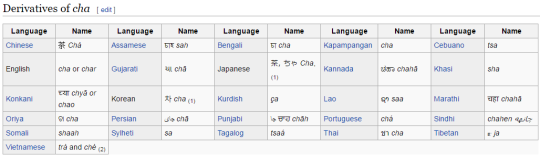
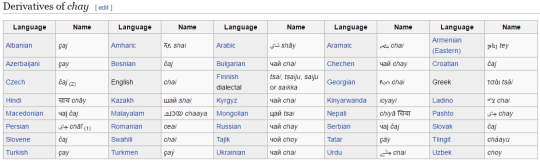
Also, specifically with the chai/tea thing, many languages either use the Malay root and end up with a word that sounds like “tea” (like té in Spanish), or they use the Mandarin root and end up with a word that sounds like “chai” (like cha in Portuguese).
So, can we all stop making fun of this now?
Okay and I’m totally going to jump in here about tea because it’s cool. Ever wonder why some languages call tea “chai” or “cha” and others call it “tea” or “the”?
It literally all depends on which parts of China (or, more specifically, what Chinese) those cultures got their tea from, and who in turn they sold their tea to.
The Portuguese imported tea from the Southern provinces through Macau, so they called tea “cha” because in Cantonese it’s “cha”. The Dutch got tea from Fujian, where Min Chinese was more heavily spoken so it’s “thee” coming from “te”. And because the Dutch sold tea to so much of Europe, that proliferated the “te” pronunciation to France (”the”), English (”tea”) etc, even though the vast majority of Chinese people speak dialects that pronounce it “cha” (by which I mean Mandarin and Cantonese which accounts for a lot of the people who speak Chinese even though they aren’t the only dialects).
And “chai”/”chay” comes from the Persian pronunciation who got it from the Northern Chinese who then brought it all over Central Asia and became chai.
This is the post that would make Uncle Iroh join tumblr
Tea and linguistics. My two faves.
Okay, this is all kinds of fascinating!
Quality linguistic research
Btw I love how most languages pick one, but Finnish is like “ok we call it ‘tee’ officially, but these few dialects call it tsai/tsaiju/saikka/saiju”.
And then there’s Polish and friends being special again with herbata.
In French we have “Thé” which is tea, and “Tisane” which is herbal tea. But let’s face it, tea and herbal tea is pretty much the same thing and I have no idea why there are two names for the same damn thing other than the fact that herbal tea is slightly lighter in colour than tea.
English, the language that mugs other languages in back alleys and rummages in their pockets for spare vocabulary.
Chapters: 1/1 Fandom: Black Sails Rating: Teen And Up Audiences Warnings: No Archive Warnings Apply Relationships: Captain Flint/Thomas Hamilton, Miranda Barlow/Captain Flint/Thomas Hamilton, Miranda Barlow/Thomas Hamilton, Miranda Barlow/Captain Flint Characters: Miranda Barlow, Captain Flint (Black Sails), Thomas Hamilton Additional Tags: wherein Miranda is alive, but her men think she’s dead, misunderstandings are had, Happy Ending, Alternate Universe – Canon Divergence, wherein the author plays with Homeric themes, and also showcases her hatred of winter, Miranda Lives AU, Miranda Hamilton Appreciation, Miranda Barlow Appreciation Summary:
Thomas thinks he might be mad the day he starts seeing Miranda’s ghost.
FlintHamilton headcannon: Thomas’s animal magnetism doesn’t end with people. He is beloved of the local cat population as well. At the plantation (before they leave) James is disgruntled because he finally has the love of his life back and he has to share their bed with every barn cat in a three mile radius. He can’t fault them for their wanting to curl up on Thomas though, and when they finally settle James knows it won’t be long before a cat or two arrives.
Ah, Anon, I do believe you’ve guessed what I’m working on! There’s a decent amount of Charles in this chapter:
Charles starts, and she sits down next to him.
Charles bows his head.
Charles nods.
She has just enough time to shake her head before Cornelius walks back through the door, and then there is only the washing, and blood, and Charles’ hand on her own, squeezing until it is over.
He takes a brief moment to thank whatever God has made them both that he has provided such infinite means of satisfying their urges, then recalls that such a prayer is probably sacrilegious at the very least, which reminds him of something he had meant to tell James – something he had thought on, in the interminable years without him, that his lover and Miranda would have – appreciated –
Frustrated:
Frustrated doesn’t appear but frustration does, so here you have it!
His lover’s skin gleams with sweat- his chest is heaving, his eyes are screwed shut, and then they flutter open, and he looks up at Thomas, frustration flickering over his face.
Sausages does not make an appearance, but oddly enough another breakfast food that’s related does, so I’m stretching the definition a bit:
“I don’t know about you,” James says, leaning closer and speaking quietly, “but I intend to go and see if the cook can’t be prevailed upon to liberate a few eggs and slice some ham since they saw fit to butcher three pigs not long ago. I’d imagine they’ll need the room in their stores. Care to join me?”
Chapters: 1/1 Fandom: Black Sails Rating: Not Rated Warnings: No Archive Warnings Apply Relationships: Hal Gates/Admiral Hennessey, Miranda Barlow/Captain Flint/Thomas Hamilton Characters: Captain Flint (Black Sails), Thomas Hamilton, Miranda Barlow, Admiral Hennessey (Black Sails), Hal Gates, Charles Vane, Muldoon (Black Sails), Assorted other Walrus crew, “Calico” Jack Rackham, Anne Bonny Additional Tags: Tooth-Rotting Fluff, Fluff, post Full of Grace, Families of Choice, In Which Pancake Day is a Thing in Nassau Series: Part 7 of Graced Summary:
They are, perhaps, doing Lent backwards, James thinks. After all – they have come from deprivation into what appears to be Hal Gates’ attempt to put fifty pounds on himself and Thomas in one day, to say nothing of the rest of the crew.


 Meg's Mumbles